


























 Algeria
  Egypt
Egypt  Israel
  Jordan
  Lebanon
  Libya
Libya  Morocco
  Palestine *
  Syria
Syria  Tunisia
 Sustainable Energy Access & Climate Action Plan Al Salt


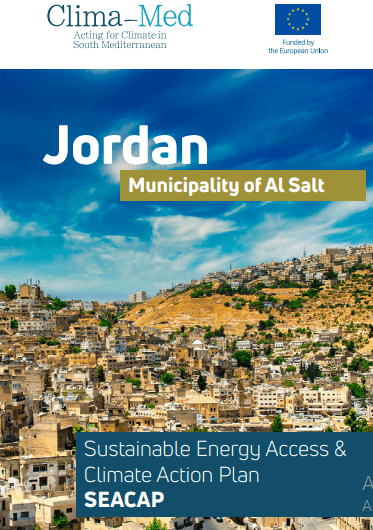
Al Salt is an ancient agricultural town and administrative centre in west-central Jordan, 29 km west of Amman with a population of 143,626 covering a 48 km2 mountainous area. It’s location on the old main highway leading from Amman to Jerusalem makes it a strategic historical place as an important trading link between the eastern desert and the west. Al Salt is famous for its fertile soil and the quality of its fruit and vegetable harvests, particularly olives, tomatoes, grapes, and peaches. The city has also an active tourism sector with a number of facilities and sites giving the area a touristic character with a lot of heritage and religious locations.
This document comprises the municipality’s Sustainable Energy Access and Climate Action Plan (SEACAP). It is a strategic planning document as well as a practical municipal operational tool. It defines the city’s climate action framework with quantifiable objectives to be reached by 2030 based on a Baseline Emissions Inventory (BEI) and an assessment of climate adaptation, mitigation, and sustainable energy needs. The SEACAP was developed under the framework of the European Union’s Clima-Med project (Acting for Climate in South Mediterranean Cities). It complements and is in line with national climate strategies and goals as well as with local development plans. The SEACAP was prepared with the full participation of the municipality’s leadership, its technical team, and in collaboration with the National Coordination Group led by the Ministry of Environment, the Clima-Med National Focal Point.


Latest Publications


